
Summary
Stem (STEM) has pivoted from a low-margin battery resale business to a comprehensive solar and battery optimization software provider.
Non-GAAP gross margins have reached a record 55% thanks to this strategic shift.
Substantial TAM expansion in the solar and battery sectors is a significant tailwind for the company.
The company is cheap on paper, trading for less than 1x ARR, but the legacy of the old business model has led to a significant debt profile and declining revenues.
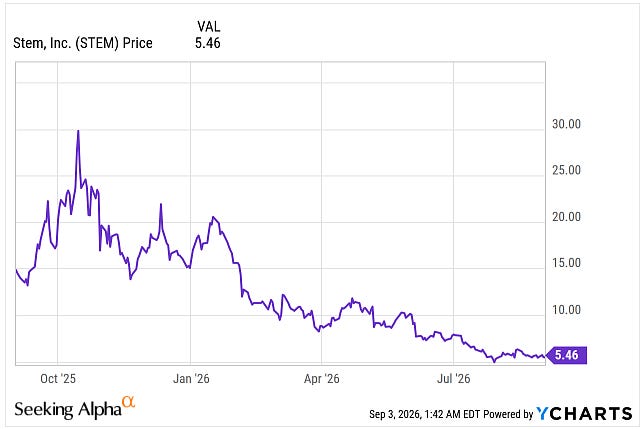
Stem (STEM) currently has a $54 million market cap.
The company sells software that monitors, controls, and optimizes clean energy assets. Solar farms, battery storage, and increasingly hybrid sites are using Stem’s software, called PowerTrack.
Their software touches projects in 55 countries. As of Q2 2026, they had 38 GW of solar and 1.8 GWh of storage under management.
Stem has been public since 2021, and earlier in its life– this was a behind-the-meter battery company reselling hardware at thin margins with software bolted on top. That model has been grossly unprofitable and has driven the company to dire straits.
Starting in 2024, management deliberately shrank the hardware business and pushed everything toward software.
The margin side of that transition is working. Revenues have not caught up yet.
While I can appreciate this shift to a capex-light software model, I think Stem needs more time to prove they can reach a positive net income.
Until that growth potential is proven out further, I have to rate the company a Hold.
Products
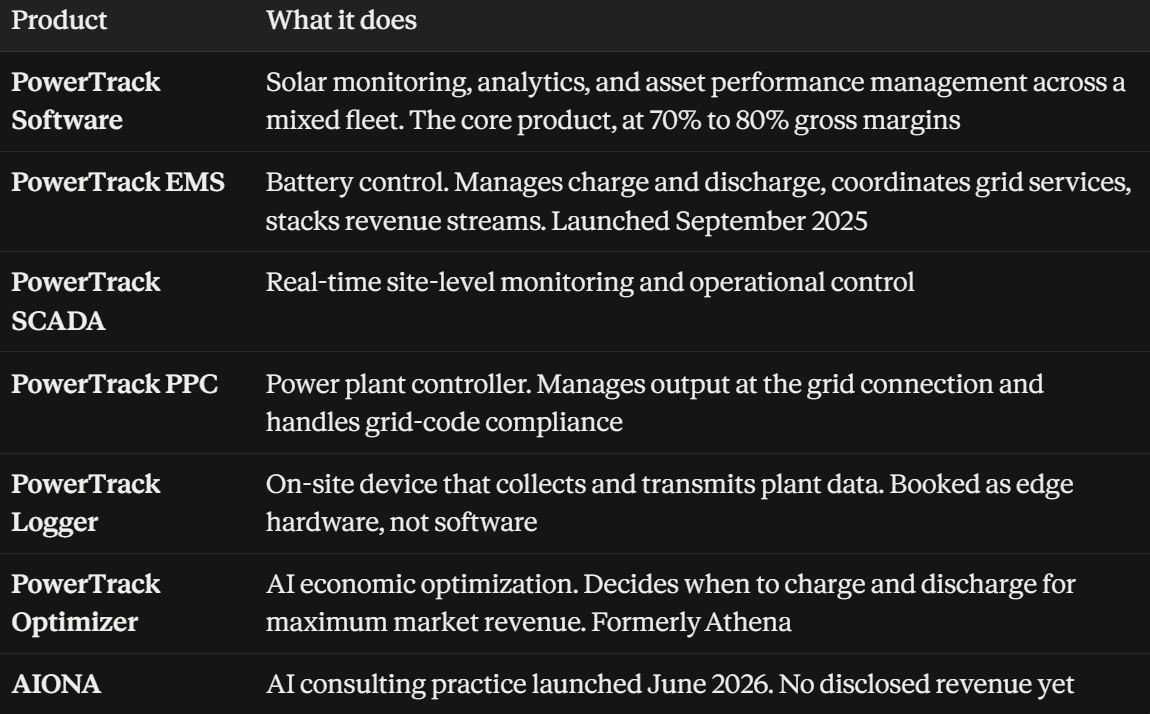
PowerTrack is the overall name of their software, and there are several different offerings.
PowerTrack Optimizer is asset performance management. It monitors, detects faults, and reports across mixed fleets. It’s hardware-agnostic, meaning it can ingest data from many inverter and battery brands.
The PowerTrack platform delivers up to a 3-5% reduction in operating expenses and a 1-5% increase in total energy production.
PowerTrack EMS is the energy management system, providing real-time control for battery sites.
And PowerTrack SCADA/PPC handles supervisory control and grid-code compliance.
Stem has also acquired the software assets of Raicoon, a Vienna-based provider of automated fault detection and event management for solar asset performance.
It’s also worth noting that they launched AIONA, an AI services offering. Right now this is a product focused on consulting for project roadmap planning, building AI agents, and systems integration.
Raicoon and AIONA represent further opportunities to drive upsells to new and existing customers. Revenue potential is unknown for now; we will have to wait and see how much of an impact these additions can make.
Business Model
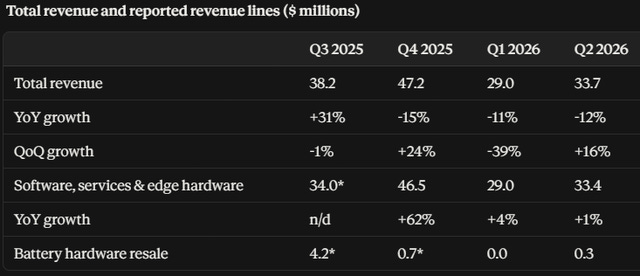
When looking at this chart, keep in mind that Stem experiences seasonal demand, with Q4 being the best quarter and Q1 being the worst. Winter constraints on projects, tax incentive deadlines, and developers rushing to hit year-end deadlines all contribute to that trend.
Here is Q2 2026 revenue of around $34 million broken out:
PowerTrack software brought in roughly $11 million, up 11% year over year. That is the recurring SaaS.
Edge hardware, meaning the physical data collection and control devices installed at sites, was roughly $15 million and up 22%.
Managed services came in around $6 million, down 34%.
Project and professional services were about $2 million, down 6%.
And battery hardware resale, which used to be the biggest line item in the whole company, contributed roughly $300,000. So battery resale has almost been totally phased out now. This is what has led to material revenue declines.
Add the first four together, and you get $33.4 million, up 1% from $32.9 million a year ago.
So the core business is flat. The 12% headline decline is almost entirely the phase-out of battery resale.
Annual recurring revenue (ARR) ended the quarter around $62 million. PowerTrack accounts for $43 million of that, and managed services $19 million. Contracted ARR, which includes signed deals on systems not yet operating, is $69.0 million.
The business is now capital-light, but revenues will need to grow significantly to save this stock. Capex in the first half of the year was only $2.6 million, all allocated to software development.
Recurring revenue only makes up $62 million of a guided $140 to $190 million. Edge hardware and project services are transactional and lumpy. This is a software business with a legacy hardware segment that will take time to fully offload.
The company has now entered Latin America, with a key focus on growth in Chile and Colombia.
Industry
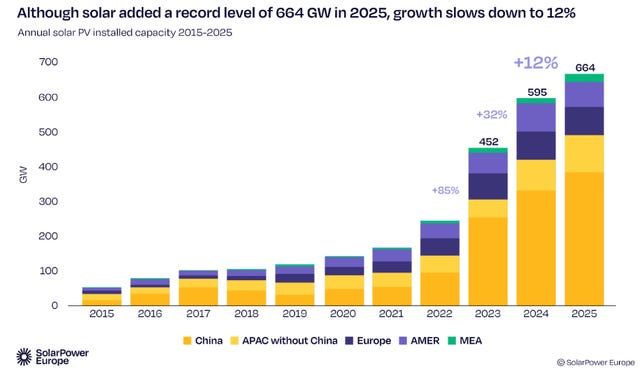
Stem sits at the intersection of two markets. Solar expansion and a battery storage boom.
This trend is being driven by data center energy demand and a desire for energy security amid instability in the Middle East. Not to mention solar panel costs declining significantly over the last decade.
The world installed a record 664 GW of solar in 2025, up 12% year over year, and solar accounted for 77% of all new renewable capacity added globally that year.
The total global solar fleet crossed 3 TW in early 2026, having tripled in roughly four years.
Storage is the faster-moving half. BloombergNEF counted 112 GW and 307 GWh of new battery storage additions globally in 2025, and forecasts 158 GW and 459 GWh for 2026. That is 41% growth in a year when solar volumes are actually expected to shrink. It only took four years for annual storage additions to go from 10 GW to over 100 GW, compared to eight years for solar.
Meanwhile, Stem currently has 38.3 GW of solar under management, which is roughly 1% of the 3 TW global fleet. In addition, Stem has 1.8 GWh of storage under management, compared with the 307 GWh the world added in 2025 alone.
So the pool of potential clients is enormous relative to what Stem has captured. Every one of those projects needs monitoring, and increasingly every solar site being paired with battery capacity needs a control system that can handle both.
With that said, Stem has been in this market for 15 years and holds barely 1% of it. Their core revenue grew 1% last quarter while the storage market grew 41%. Part of this lag may be the competitive landscape.
Competitors
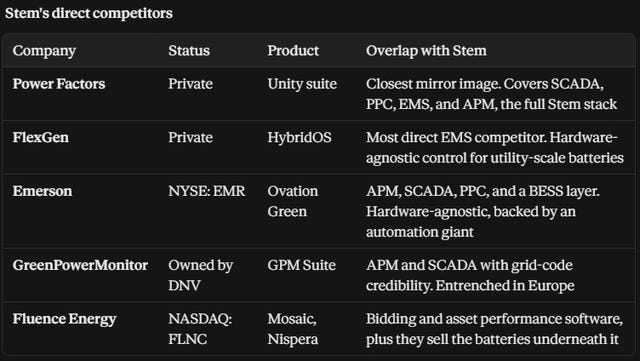
Power Factors is the closest comparison. They’re competing directly on asset performance management for mixed renewable fleets. Generally considered the scale leader in independent APM. Power Factors manages 310+ GW of wind, solar, and storage capacity, so 10x the capacity of Stem.
FlexGen competes head-on with HybridOS, a hardware-agnostic EMS for utility-scale battery fleets.
Fluence Energy competes with its own asset performance management (APM) offering.
GreenPowerMonitor, owned by DNV, brings certification credibility and grid-code depth in Europe, which is one of the main regions where Stem is trying to expand.
Then you have Tesla with Autobidder, plus hardware vendors like Sungrow, all competing by bundling free or near-free software with their own equipment.
Stem’s initial focus on a capex-intensive battery resale business has severely dampened growth potential and has left them with a significant debt profile.
Stem can’t outspend anyone on R&D. Q2 research and development was $6.5 million, down 35% year over year.
The massive collapse of the stock price makes any additional dilution painful for existing stockholders. A main bottleneck will end up being the ability to raise funds– which they don’t have.
The only moats to speak of are switching costs for projects already integrated into their platform and some regulatory barriers for certifications where Stem is already established. I don’t consider either very strong, as Stem doesn’t hold a significant market share.
Share Structure
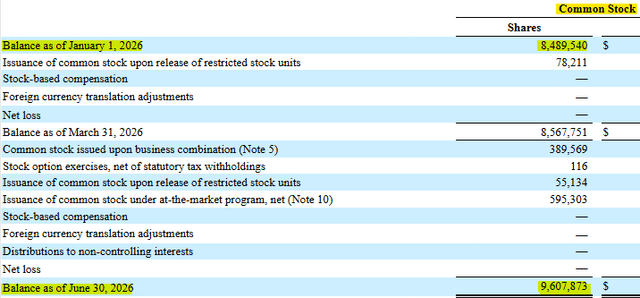
Stem executed a 1-for-20 reverse split in June 2025 to regain NYSE compliance. That took shares outstanding from 167 million down to 8.36 million.
As of June 30th, 2026, there are now 9.6 million shares outstanding.

Potentially dilutive securities total roughly 2.7 million shares. That breaks down to about 1.15 million RSUs, 172k stock options, 440k private placement warrants, and convertible notes representing roughly 950k shares.
That’s a 28% overhang on the current share count. The 2028 notes convert at $584.86 and the 2030 notes at $142.55. With the current stock price at $5.57, they’re not much of a concern.
A larger issue is a new ATM. Stem has entered a $30 million at-the-market program with Jefferies. Through June 30th, they issued 595,303 shares for $5.6 million. Whether it’s dilution or debt, the profitability issues are eating away at this company.
There has been zero insider buying in the last 12 months. Only selling. Not encouraging.
Financial Analysis
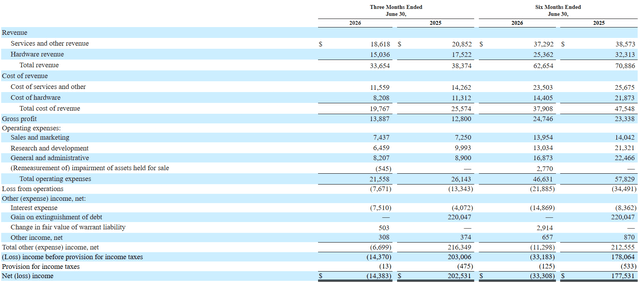
In Q2 2026, revenue came in at around $34 million, down 12% year over year and short of roughly $37 million consensus.
GAAP gross margin improved to 41% from 33%, and non-GAAP gross margin hit a record 55%, up from 49%.
Over the last several quarters, operating loss narrowed to $7.7 million from $13.3 million. Net loss was $14.4 million. Adjusted EBITDA was $6.2 million, up 63%, marking the fifth consecutive positive quarter. And operating cash flow was positive $0.3 million versus negative $21.3 million a year ago.
Gross margin has expanded consistently, from 46% non-GAAP in 2025 to 54% in the first half of 2026. Operating expenses fell from $57.8 million to $46.6 million year over year. Adjusted EBITDA went from negative $22.8 million in 2024 to positive $6.7 million in 2025, to $8.2 million in the first half of 2026 alone.
While things are improving margin-wise, they need some serious revenue growth and bottom-line progress to reach a better place.
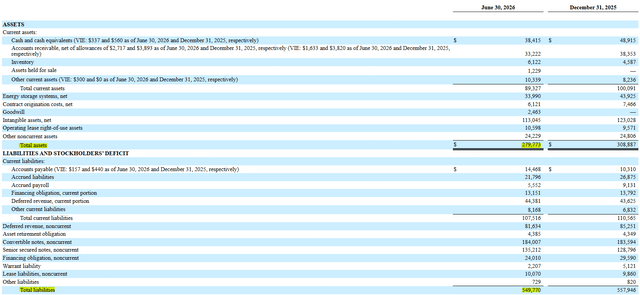
Turning to the balance sheet, cash was $38 million. Total assets were $280 million, of which $113.0 million is intangibles. Total liabilities came to $550 million, including $107 million in current liabilities and roughly $440 million in long-term debt.
On the debt structure, in June 2025 Stem exchanged $350 million of convertibles for $155.4 million of new first-lien notes due December 2030, plus warrants and $10 million in cash. That cut roughly $195 million of debt.
Interest expense was $7.5 million in the quarter and $14.9 million in the first half. That tracks toward roughly $30 million annualized.
Full-year adjusted EBITDA guidance is $10 to $15 million. Which means they’re not even covering their current interest.
On guidance, they reaffirmed everything on the Q2 call. Revenue of $140 to $190 million, core revenue of $130 to $150 million, battery resale up to $40 million, and year-end ARR of $65 to $70 million.
That’s a 23% step up in a business that declined year over year in both quarters. The projections seem a bit unreasonable without assuming substantial revenue growth.
Risks
The worst is the debt. Roughly $550 million in total liabilities against $38 million in cash isn’t a great start. Interest expense runs about two times adjusted EBITDA.
Dilution is immediate. The ~$24 million of unused ATM capacity is 45% of the current market cap.
On the regulatory side, Stem names the One Big Beautiful Bill as a direct uncertainty affecting customers and suppliers, alongside tariffs.
Then there’s technology risk. R&D spending is down 35% year over year while better-capitalized rivals are eating up potential market share.
Listing risk is real too. Another compliance problem is plausible if the stock keeps sliding. Then you end up on the OTC with decreased access to capital and institutional investors.
Conclusion
The software transition is real. Fifth straight quarter of positive adjusted EBITDA, record 55% non-GAAP gross margins, opex down 19% year over year; the turnaround is in progress.
Trading at less than 1x ARR, it theoretically screens cheap for a software business.
An average public company in the SaaS space trades at around 6-8x ARR. Granted, Stem seems to deserve the low multiple for now.
Competition is a problem, but the target sectors are so large, with massive growth rates– it may not matter.
The caveat is consistent profitability issues and a business technically in decline as the battery resale model will be phased out.
It’s pretty much a coin flip to see how the next 1-2 years play out.
If they hit guidance and manage to get the debt situation under control, the stock could re-rate.
If revenue growth disappoints, we see continued dilution and serious liability concerns.
I can’t give the stock a Buy rating under these conditions; there are simply too many risks.
Until they make notable strides on the revenue front, onboarding more software clients- it’s worth watching how the turnaround goes, but I wouldn’t go any further than that for now.
Disclaimer
This content is for informational purposes only, you should not construe any such information or other material as legal, tax, investment, financial, or other advice. Nothing contained in this video constitutes a solicitation, recommendation, endorsement, or offer by Green Investing to buy or sell any securities or other financial instruments in any jurisdiction.
All content in this video is information of a general nature and does not address the circumstances of any particular individual or entity. You alone assume the sole responsibility of evaluating the merits and risks associated with the use of any information or other content in this video before making any decisions based on such information.
I like Energy Vault in this space. It is a bit of an apples to oranges comparison but Energy Vault apparently has a great energy management software system that is helping their business grow.