

The EU Caved
On July 17th, 2026, the European Commission published COM(2026) 616, a long-anticipated revamp of the EU Emissions Trading System. The compliance carbon market that encompasses roughly 40% of the bloc’s total emissions.
The EU’s binding goal of a 90% net reduction against 1990 emissions numbers by 2040, of which at least 85% must be achieved domestically… can be a bit daunting for heavy-polluting industry.
As expected during a time of extreme geopolitical and economic turmoil, the EU is set to dial back some ambitious aspects of the program.
With prices rising broadly across the region, it’s no surprise that they are looking to shake things up. And this is why I have always advised against investing in industries reliant on government-driven markets or subsidies. At any moment, they might change the rules— and now you’re a bagholder in a sector begging for government handouts.
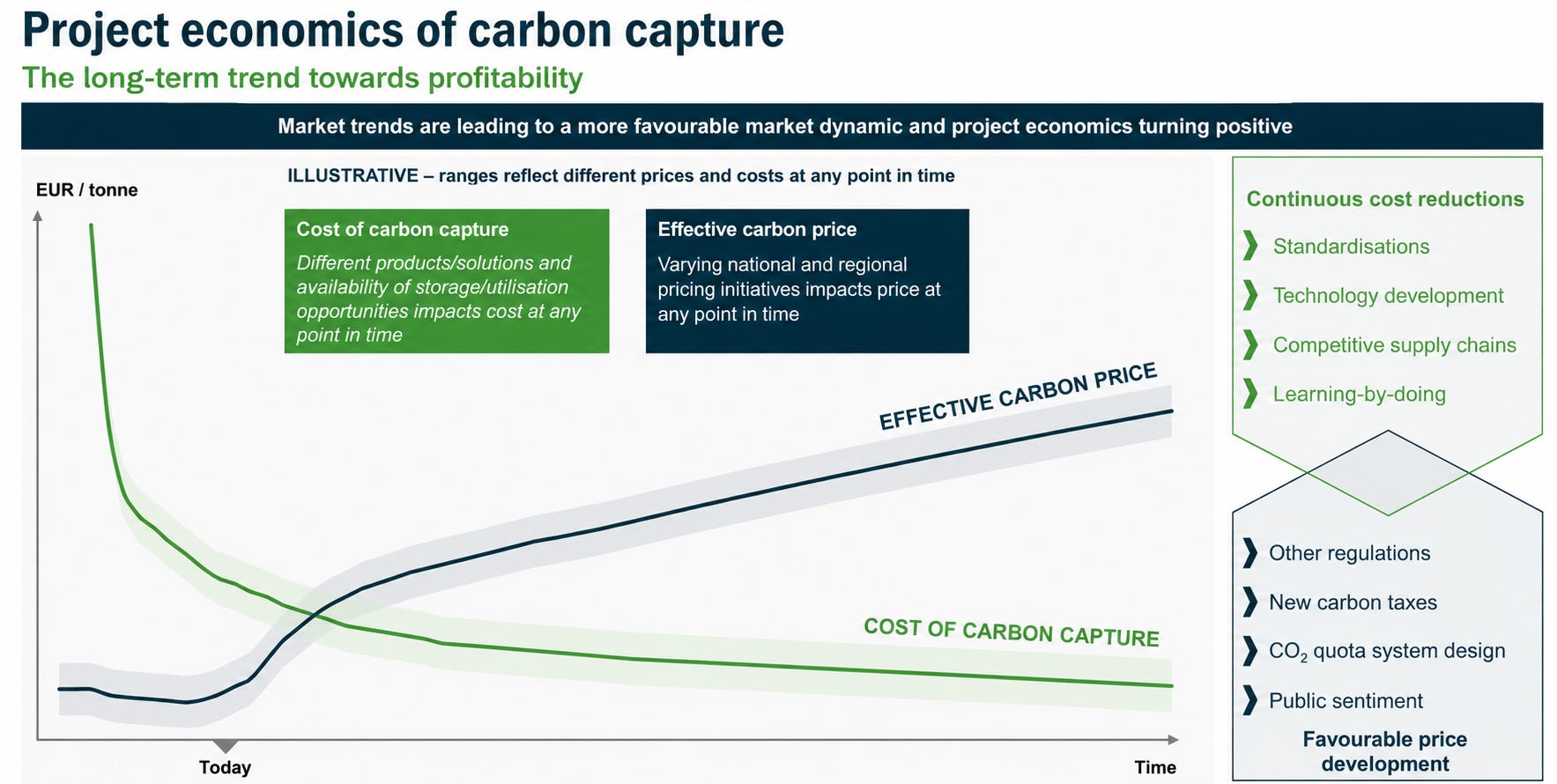
The state of EU Carbon Allowance (EUA) economics determines the financial viability of entire industries in the European region, like green hydrogen or carbon capture.
Technology standardizations over time as more projects are built, and a rising carbon price leads to profitability. Obviously, like any commodity, if the price falls… then that will eat into the cash flows from these projects.
This post will review the aspects that I think investors should know about investable industries, not the entirety of what was included in the document.
Before we conduct a deep dive into what changes are on the docket… keep in mind this is a proposal, not the law of the land. Negotiations will be ongoing in 2027, and a final draft will take effect in 2028.
1. Slowing the Emissions Cap Decline
The EU Commission has proposed a linear reduction factor (LRF) of 3.7% for 2031–35 and 1.7% from 2036, versus 4.3–4.4% today. This refers to the emissions cap instituted by the program, which is set to decrease over time. So, allowances would keep being issued into the 2040s rather than running out by 2039.
This, of course, will lead to lower carbon allowance prices over the long run and stalls the pricing increase that would encourage energy-intensive industries to make a concerted effort to lower their emissions. Rather than just paying for allowances.
You can view the current price of EUAs here. Also known as permits.
2. Extending Free Allocation to 2038
To prevent businesses from moving away to avoid lowering emissions, the EU ETS allocates free allowances to energy-intensive industry. This is known as “carbon leakage.”
This policy was set to be ramped down between 2026 and 2034… now free allocation extends through 2040 (with CBAM phase-in slowed, extending free-allocation phase-out to 2038).
This directly lowers compliance costs for steel, cement, aluminum, fertilizers, hydrogen and electricity production. With that said, 80% of free allowances are now conditional on having a decarbonization plan in place from 2031, with the final 20% contingent on demonstrated emissions cuts.
3. Market Stability Reserve Reforms
The Market Stability Reserve (MSR) is an automated mechanism designed to balance the supply and demand of carbon allowances. It adjusts auction volumes by absorbing excess permits when a surplus occurs or releasing allowances back into the market during times of scarcity.
When total allowances in circulation (TNAC) exceed the upper threshold (1 billion allowances), fewer allowances are released into the market in auctions. And vice versa. The lower threshold is roughly 400 million.
Four changes are set to take effect if this legislation is approved:
A new, lower buffer from 2028
Dynamic thresholds declining 4% per year from 2029
EUA intake rate halved to 12% from 2028, compared to 24%
Folding cumulative 2012–2023 aviation demand into the TNAC, reducing the lower threshold by 173 million allowances, which makes the reserve release allowances earlier
TLDR, this releases more allowances to the market sooner and dampens EUA prices. Once again, carbon-intensive sectors are set to benefit.
4. Buying 260 Mt of Article 6 International Credits
The proposal allocates up to 260 million allowances to be auctioned to fund the purchase of up to 260 million tons of high-integrity Article 6 credits between 2036 and 2040.
Around ~180 million credits represents the current demand in the voluntary carbon markets per annum, as of this post. So, depending on the price of the Article 6 credits the EU ETS would be buying…
That would equate up to 3x the current VCM demand levels over the span of four years. Now, this proposal is not finalized and we are talking about a plan that would take effect a decade from here.
But, it’s certainly not a negative for players in the VCM space.
5. Permanent Carbon Removals (BioCCS & DACCS)
The proposal raises the ETS emissions cap by 250 million allowances, auctioned 2031–2040 to fund purchases of CRCF-certified BioCCS and DACCS removal credits.
Bioenergy with carbon capture, and direct air capture. Biochar and other removal options have been left out, which has sparked debate…
At a €200 per ton baseline carbon price, procuring 250 million tons across 2031–2040 implies a €50 billion compliance market for domestic CDR, with annual government-backed spend approaching €10 billion by 2040.
There’s skepticism about how many tons the government would actually buy, since selling 250 million allowances does not guarantee being able to buy 250 million removal credits. CDR credits cost at least a few hundred euros per ton. We’ll see.
As with the other changes, we are talking about timelines over a decade out. But these do represent long-term boons for these industries and can increase market certainty when making investments in carbon capture projects.
6. Financial support for Decarbonization Investment
The ETS has raised roughly €260 billion since 2013, the vast majority flowing to national treasuries. Member states are already required to spend 100% of that on climate and energy purposes, but the Commission has found that reporting is opaque and enforcement is weak. It’s estimated that only about 5% of national ETS revenues currently reach industrial decarbonization.
To solve for this, the EU has established the Industrial Decarbonization Bank (IDB) with €100 billion in total funding drawn from ETS revenues. Divided into two phases.
Phase one will be financed through the sale of 400 million allowances from 2028 to 2030. This phase is expected to deliver around €30 billion in support to decarbonization efforts.
Phase two is from 2031 and onward, also financed with a further 400 million allowances to fund Carbon Contracts for Difference (CfD). These are essentially a carbon pricing floor/ceiling to establish financial certainty for decarbonization projects. De-risking investments.
The Innovation Fund remains in place, one of the world's largest funding programs for commercializing net-zero and low-carbon technologies. The fund is backed by roughly €40 billion through 2030. It covers up to 60% of eligible project costs to scale green technologies.
These funding mechanisms are great news for novel or generally uneconomic technologies like hydrogen, carbon capture, batteries, etc.
7. Minimum Green Spending Requirements
Member states will be required to spend at least 50% of their ETS auction revenues on investments that reduce emissions in ETS-covered sectors. Against a current average of roughly 5%, that’s a tenfold increase.
Revenues must be spent on clean energy/grids, low-carbon transportation, industrial decarbonization, or research and innovation.
Winners
I would separate the clear winners into three categories:
Carbon-intensive industry
Longer access to free allowances, slowing the decline in the emissions cap, etc, benefit heavy emitters.
Carbon credit project developers
Buying Article 6-certified carbon credits represents a significant demand increase. Granted, this would take place a decade from now. Government support still leads to more investment as certainty improves for investors.
Investment options:
Base Carbon (BCBNF) is the only company with an inventory of Article 6-certified credits, sourced from the cookstove project they financed in Rwanda.
Carbon capture
CCS is a winner in the long term and a loser in the short term. Guaranteed demand from the EU ETS ecosystem and other means of financial support represent a large boon for the industry, but it’s set to take effect a decade from now. It still bolsters investments in the future, but weaker carbon pricing hurts present-day economics.
The primary issue with carbon capture is that… nearly all of these companies are private. Aker Carbon Capture was likely the best option, but that company was delisted in 2025. There are still a few…
Investment options:
Drax Group (DRXGY) operates a portfolio of renewable energy assets, mostly in the UK, including bioenergy and carbon capture. If the UK ETS is linked with the EU ETS, they may benefit from these changes.
LanzaTech (LNZA) has six operational plants across China, Belgium, and India using their licensed technology to convert CO2 into ethanol. Lanza also has the LanzaJet joint venture, an SAF plant operator. Be careful with this company as they have profitability issues and continue to raise money through private placements.
Losers
Lower carbon pricing leads to the losers you would expect:
Carbon Allowance ETFs
KraneShares Global Carbon Strategy ETF (KRBN) is the most liquid and has seen a slow decline since 2022. The changes made under political pressure will continue to be bearish for EUAs. This represents 55-60% of the total allowances held in the fund.
Carbon capture
A probable winner in the long-term via government intervention, and a loser in the short and medium-term.
Green hydrogen
Economics have already declined and taking losses in both the USA and EU with shifting political attitudes. Not a good industry to be in, for now.
Any capital-intensive and currently uneconomic projects
We just saw Air Products cancel their planned $4.5 billion hydrogen and ammonia facility with CCS in Louisiana. I expect that trend to continue with more projects getting canned as support wanes.
Again, I would wait before acting on any of these EU ETS changes as they have yet to be approved. We’ll have to see how they turn out next year.
Disclaimer
This content is for informational purposes only, you should not construe any such information or other material as legal, tax, investment, financial, or other advice. Nothing contained in this video constitutes a solicitation, recommendation, endorsement, or offer by Green Investing to buy or sell any securities or other financial instruments in any jurisdiction.
All content in this video is information of a general nature and does not address the circumstances of any particular individual or entity. You alone assume the sole responsibility of evaluating the merits and risks associated with the use of any information or other content in this video before making any decisions based on such information.